Meta — 2026
Meta — 2026
Re-imagining AI-driven investigations
Re-imagining AI-driven investigations
Meta anchors its global ecosystem across Facebook, Instagram, WhatsApp, Messenger, and Threads, reaching approximately 3.98 billion active users and generating over $200 billion annually across more than 190 countries. Protecting this scale from bad actors is vital. While machine learning handles bulk enforcement, complex threats require specialized human expertise, law enforcement partnerships, and cross-functional collaboration. Leveraging this landscape, I had the opportunity to reimagine AI-led investigations to empower and accelerate these high-impact safety operations.
NDA NOTE
Due to NDA restrictions, this case study is a simplified concept inspired by the work rather than the final product that shipped. Details have been adapted to protect confidential information.
Role
Role
Lead Product Designer
Lead Product Designer
Tools
Tools
Figma, FigJam, FigmaMake, VSCode, Claude Code
Figma, FigJam, FigmaMake, VSCode, Claude Code

Image 1 — meta 2026.
TL;DR
TL;DR
As Lead Designer for Specialized Human Review, the team tasked with protecting the integrity of Meta's family of apps against the most complex threats across 190 countries, I championed the reimagining of AI-led investigations to tackle the platform's most difficult cases. I drove an AI-first vision to unify fragmented internal tools into a single platform for 15,000 monthly active investigators. By streamlining workflows, we drastically reduced training time and eliminated technical roadblocks while automating repetitive investigative tasks, always keeping human experts at the center for final decision-making. Through a rapid design sprint and close cross-functional partnership with Product, Research and Engineering, we delivered a live pilot in just three months, significantly accelerating AI-led investigations at scale by 95% reduction in handing time.
As Lead Designer for Specialized Human Review, the team tasked with protecting the integrity of Meta's family of apps against the most complex threats across 190 countries, I championed the reimagining of AI-led investigations to tackle the platform's most difficult cases. I drove an AI-first vision to unify fragmented internal tools into a single platform for 15,000 monthly active investigators. By streamlining workflows, we drastically reduced training time and eliminated technical roadblocks while automating repetitive investigative tasks, always keeping human experts at the center for final decision-making. Through a rapid design sprint and close cross-functional partnership with Product, Research and Engineering, we delivered a live pilot in just three months, significantly accelerating AI-led investigations at scale by 95% reduction in handing time.
KEY IMPACT & SCALE
3 Months
3 Months
Taken from concept to a fully shipped live pilot product through rapid design sprints.
Taken from concept to a fully shipped live pilot product through rapid design sprints.
Unified Experience
Unified Experience
Consolidated fragmented 16 internal investigation tools into a single, cohesive workspace.
Consolidated fragmented 16 internal investigation tools into a single, cohesive workspace.
95% Reduction in Handling
95% Reduction in Handling
Decrease in investigation handling time from 55 min to 4min and projected to save 25,057 hours anually during the initial pilot release with zero critical issues.
Decrease in investigation handling time from 55 min to 4min and projected to save 25,057 hours anually during the initial pilot release with zero critical issues.
AI-First
AI-First
Reimagined AI-led investigations to dramatically boost efficiency through automation and lower cognitive load.
Reimagined AI-led investigations to dramatically boost efficiency through automation and lower cognitive load.
Context
Context
The Product Suite: Meta’s digital ecosystem spans nearly 3.98 billion monthly active users. Protecting this vast network falls to the Central Integrity team, which actively neutralizes severe threats such as fraud, criminal networks, and human exploitation.
While automated systems efficiently handle bulk enforcement, our Specialized Human Review unit is deployed for the most complex, high-impact cases. These novel threats demand deep human expertise, strategic judgment, and cross-functional collaboration with law enforcement, regulators, and legal teams. Because these intricate investigations can span months, they are nearly 40 times more expensive than automated reviews. This investment is increasingly critical, as the volume of these high-stakes investigations surged to over 12 million in 2025—a nearly 4x increase since 2023.
This project reimagines AI-driven investigations to modernize Specialized Human Review. The goal is to enhance the overall investigator experience, increase decision accuracy, and drastically reduce operational costs.
The Environment: We operated in an agile framework with weekly cross-functional sprints across product, engineering, design, and research. To meet an aggressive three-month launch goal for our live pilot, our disciplines worked in tight parallel execution. To accelerate velocity, Design owned both the user experience and the front-end implementation. This approach ensured the UX was built exactly as intended while freeing Engineering to focus exclusively on complex backend infrastructure and integrations.
The Background: Historically, Specialized Human Review was hindered by high operational costs, fragmented tooling, and steep training requirements. As the company shifted its focus toward AI-driven workflows, this domain was identified as a key strategic opportunity for transformation. By leveraging the contextual awareness and advanced reasoning capabilities of generative AI, we aimed to dramatically accelerate and optimize the complex investigation process.
My role: As Design Lead, I drove the strategy and end-to-end UX for the new AI-led investigation platform. I ensured the product not only supported our immediate core use cases but was fundamentally architected to scale across all specialized investigation types. Working in tight parallel execution with Product, Engineering, and Research, I led design workshops and facilitated alignment sessions to successfully hit our aggressive three-month pilot launch. To maximize our speed to market, I also owned the complete front-end implementation of the designs.
The Product Suite: Meta’s digital ecosystem spans nearly 3.98 billion monthly active users. Protecting this vast network falls to the Central Integrity team, which actively neutralizes severe threats such as fraud, criminal networks, and human exploitation.
While automated systems efficiently handle bulk enforcement, our Specialized Human Review unit is deployed for the most complex, high-impact cases. These novel threats demand deep human expertise, strategic judgment, and cross-functional collaboration with law enforcement, regulators, and legal teams. Because these intricate investigations can span months, they are nearly 40 times more expensive than automated reviews. This investment is increasingly critical, as the volume of these high-stakes investigations surged to over 12 million in 2025—a nearly 4x increase since 2023.
This project reimagines AI-driven investigations to modernize Specialized Human Review. The goal is to enhance the overall investigator experience, increase decision accuracy, and drastically reduce operational costs.
The Environment: We operated in an agile framework with weekly cross-functional sprints across product, engineering, design, and research. To meet an aggressive three-month launch goal for our live pilot, our disciplines worked in tight parallel execution. To accelerate velocity, Design owned both the user experience and the front-end implementation. This approach ensured the UX was built exactly as intended while freeing Engineering to focus exclusively on complex backend infrastructure and integrations.
The Background: Historically, Specialized Human Review was hindered by high operational costs, fragmented tooling, and steep training requirements. As the company shifted its focus toward AI-driven workflows, this domain was identified as a key strategic opportunity for transformation. By leveraging the contextual awareness and advanced reasoning capabilities of generative AI, we aimed to dramatically accelerate and optimize the complex investigation process.
My role: As Design Lead, I drove the strategy and end-to-end UX for the new AI-led investigation platform. I ensured the product not only supported our immediate core use cases but was fundamentally architected to scale across all specialized investigation types. Working in tight parallel execution with Product, Engineering, and Research, I led design workshops and facilitated alignment sessions to successfully hit our aggressive three-month pilot launch. To maximize our speed to market, I also owned the complete front-end implementation of the designs.
The problem
The problem
Meta's investigative team face fragmented tools, manual workflows, and rapidly increasing case complexity. This leads to slower response times and limits their ability to address evolving threats.
Pain points:
Severe Tool Fragmentation: Investigators are forced to navigate a disjointed ecosystem of 16 tools, requiring heavy manual effort to capture, analyze, and transition data across different platforms.
High Cognitive Load & Ambiguity: Users struggle to know exactly which tool to use at specific stages of an investigation and how to use it effectively, a problem compounded by the steep learning curve required to master the complex systems.
Friction in Case Handoffs: When cases are triaged or transferred to a new team member, the receiving investigator lacks historical context. It is highly difficult to understand what has already occurred, the current status of the investigation, and the immediate next steps.
Data Silos & Inconsistency: Information is isolated within separate, non-communicating tools. This lack of a centralized source of truth leads to conflicting data, ultimately causing investigators to lose trust in the information provided.
Operational Bottlenecks: The combination of manual workflows, scattered resources, and complex navigation severely slows down overall response times, limiting the team's ability to efficiently resolve cases and adapt to novel threats.
Meta's investigative team face fragmented tools, manual workflows, and rapidly increasing case complexity. This leads to slower response times and limits their ability to address evolving threats.
Pain points:
Severe Tool Fragmentation: Investigators are forced to navigate a disjointed ecosystem of 16 tools, requiring heavy manual effort to capture, analyze, and transition data across different platforms.
High Cognitive Load & Ambiguity: Users struggle to know exactly which tool to use at specific stages of an investigation and how to use it effectively, a problem compounded by the steep learning curve required to master the complex systems.
Friction in Case Handoffs: When cases are triaged or transferred to a new team member, the receiving investigator lacks historical context. It is highly difficult to understand what has already occurred, the current status of the investigation, and the immediate next steps.
Data Silos & Inconsistency: Information is isolated within separate, non-communicating tools. This lack of a centralized source of truth leads to conflicting data, ultimately causing investigators to lose trust in the information provided.
Operational Bottlenecks: The combination of manual workflows, scattered resources, and complex navigation severely slows down overall response times, limiting the team's ability to efficiently resolve cases and adapt to novel threats.
Discovery & Design Sprint
Discovery & Design Sprint
To tackle a complex problem space, I structured the initiative into two distinct phases: grounding our strategy in rigorous qualitative research, then bringing stakeholders together for a high-intensity design sprint to co-create solutions
1. Foundational Research & Audit
1:1 User Interviews: Partnered with a user researcher to conduct qualitative interviews, mapping out core pain points and observing investigators in their live workflows.
Feature Audit: Conducted a comprehensive audit across existing investigation tools to inventory core capabilities, redundancies, and capability gaps.
Participant Selection: Used insights from the initial research to strategically identify and recruit the right users and subject matter experts for the upcoming design sprint.
2. 3-Day Design Sprint & Ideation Workshop
Cross-Team Presentations & Walkthroughs: Kickstarted the sprint by having the selected investigators present and walk through their specific workflows and toolsets, aligning the broader stakeholder team on real-world baselines.
Journey Mapping & Maturity Evaluation: Led collaborative mapping exercises to capture end-to-end user journeys, highlight operational friction points, and grade capability maturity based on priority and technical dependencies.
Problem Framing & “How Might We” Prompts: Converted journey map insights into actionable HMW prompts, driving high-volume ideation focused on quantity over quality.
Crazy Eights & Rapid Concepting: Facilitated fast-paced visual sketching sessions to quickly generate and test diverse interface concepts with stakeholders.
Strategic Alignment: Established a unified product direction and design approach, ensuring all stakeholder feedback, constraints, and initial concepts were synthesized into a clear path forward.
Strategy & Approach
Strategy & Approach
Through our research and workshop we validated that an AI-powered solution was essential to optimize the workflow. Rather than building a supplemental sidebar chat, we determined that a standalone, unified investigation platform was required. The goal is to address inefficiencies and fragmentation in current investigation tools and aim to 10x investigator impact by automating manual task and surfacing actionable insights. This strategic shift will consolidate all existing tools, centralize data, and establish a single source of truth—ultimately eliminating data fragmentation and streamlining the investigative lifecycle.
Design principals:
Build for Trust and Confidence: Features should deliver clear, transparent results and empower investigators to easily guide and improve the system while making their work simpler, not more complicated.
Prioritize Accuracy and Quality: Deliver highly accurate results from the beginning and continuously improve with user feedback, without requiring investigators to rely on unreliable outputs.
Empower Through AI assistance: Help investigators overcome uncertainty, quickly get started, and provide structure and direction to drive investigations forward.
Protect Platform Reliability: Maintain or improve system performance, latency, and reliability, ensuring the platform remains stable and dependable.
Through our research and workshop we validated that an AI-powered solution was essential to optimize the workflow. Rather than building a supplemental sidebar chat, we determined that a standalone, unified investigation platform was required. The goal is to address inefficiencies and fragmentation in current investigation tools and aim to 10x investigator impact by automating manual task and surfacing actionable insights. This strategic shift will consolidate all existing tools, centralize data, and establish a single source of truth—ultimately eliminating data fragmentation and streamlining the investigative lifecycle.
Design principals:
Build for Trust and Confidence: Features should deliver clear, transparent results and empower investigators to easily guide and improve the system while making their work simpler, not more complicated.
Prioritize Accuracy and Quality: Deliver highly accurate results from the beginning and continuously improve with user feedback, without requiring investigators to rely on unreliable outputs.
Empower Through AI assistance: Help investigators overcome uncertainty, quickly get started, and provide structure and direction to drive investigations forward.
Protect Platform Reliability: Maintain or improve system performance, latency, and reliability, ensuring the platform remains stable and dependable.
The Solution & Development
The Solution & Development
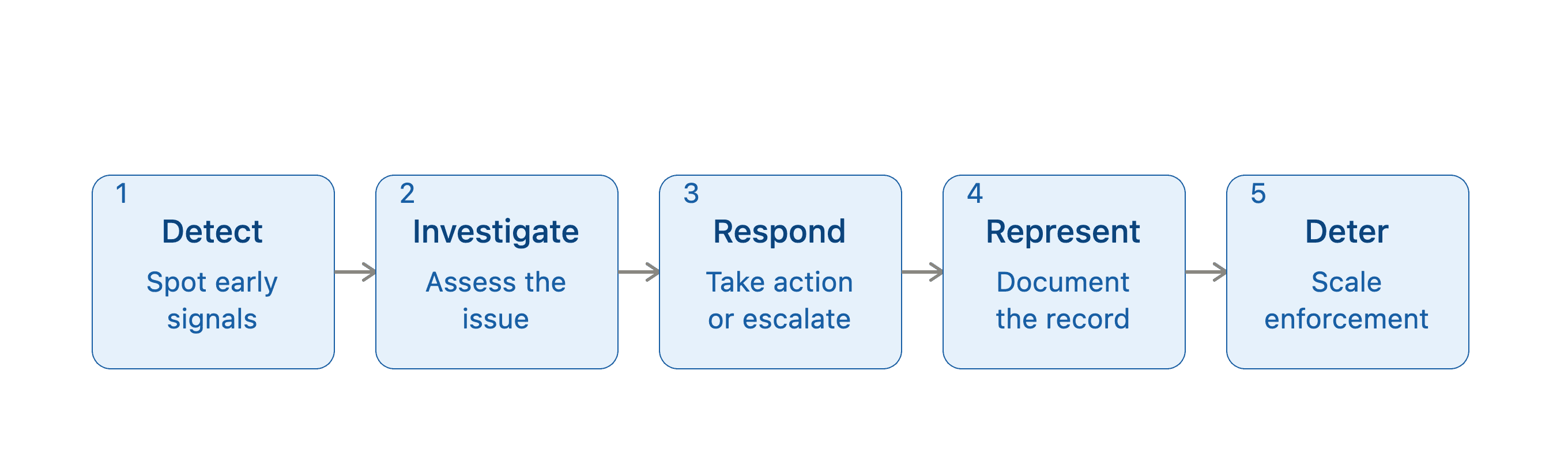
To eliminate tool fragmentation, I designed a unified, end-to-end workspace that guides investigators through the entire case lifecycle: detection, case creation, investigation, response, and enforcement. Because investigations vary widely in complexity, I anchored the design on a "hero use case"—a foundational, cross-functional workflow that is simple to track and analyze, yet robust enough to scale for massive, complex cases.
By consolidating the experience, investigators no longer need to context-switch or manually hunt for information across disparate systems. Centralizing the data creates a single source of truth, minimizing inconsistencies and breaking down data silos. To further reduce cognitive load and manual effort, I integrated an AI investigation agent that instantly analyzes data, surfaces hidden patterns, and recommends optimal actions. However, to ensure strict adherence to security, privacy, and regulatory requirements, the system operates on a human-in-the-loop model. Investigators guide the AI throughout the process and retain absolute authority over the final enforcement decision. Ultimately, this intuitive, stage-based design ensures seamless onboarding, allowing anyone to easily jump in, instantly grasp the status of an investigation, and know exactly what to do next.
To eliminate tool fragmentation, I designed a unified, end-to-end workspace that guides investigators through the entire case lifecycle: detection, case creation, investigation, response, and enforcement. Because investigations vary widely in complexity, I anchored the design on a "hero use case"—a foundational, cross-functional workflow that is simple to track and analyze, yet robust enough to scale for massive, complex cases.
By consolidating the experience, investigators no longer need to context-switch or manually hunt for information across disparate systems. Centralizing the data creates a single source of truth, minimizing inconsistencies and breaking down data silos. To further reduce cognitive load and manual effort, I integrated an AI investigation agent that instantly analyzes data, surfaces hidden patterns, and recommends optimal actions. However, to ensure strict adherence to security, privacy, and regulatory requirements, the system operates on a human-in-the-loop model. Investigators guide the AI throughout the process and retain absolute authority over the final enforcement decision. Ultimately, this intuitive, stage-based design ensures seamless onboarding, allowing anyone to easily jump in, instantly grasp the status of an investigation, and know exactly what to do next.
CAPTION
A new AI investigation tool that consolidates and automates investigative workflows.
CAPTION
AI agents automate the entire lifecycle from detection to investigation and action, enabling analysts to quickly review and validate findings.
Outcome & Business Impact
Outcome & Business Impact
Delivered the pilot experience within 3 months, hitting our target release date and driving immediate adoption across Meta's investigation teams for their entire workflow, with ongoing expansion planned to support additional teams and use cases.
Focused the initial release on the account lockout use case, identified as a high-value opportunity for AI optimization.
Reduced investigation handling time from 55 minutes down to 4 minutes—a 95% reduction per case—with zero critical issues during the initial pilot.
Projected annual savings of 25,057 hours, streamlining a process that previously required manual investigator reviews, time, and approvals.
Empowered self-serve configurations, allowing operations and investigation teams to make rapid workflow adjustments independently, as reflected in high rates of self-resolved user feedback.
Automated entity object inspection, eliminating the need for extensive manual criteria analysis, tool navigation, and insight synthesis, allowing human investigators to focus solely on final verification and validation.
Delivered the pilot experience within 3 months, hitting our target release date and driving immediate adoption across Meta's investigation teams for their entire workflow, with ongoing expansion planned to support additional teams and use cases.
Focused the initial release on the account lockout use case, identified as a high-value opportunity for AI optimization.
Reduced investigation handling time from 55 minutes down to 4 minutes—a 95% reduction per case—with zero critical issues during the initial pilot.
Projected annual savings of 25,057 hours, streamlining a process that previously required manual investigator reviews, time, and approvals.
Empowered self-serve configurations, allowing operations and investigation teams to make rapid workflow adjustments independently, as reflected in high rates of self-resolved user feedback.
Automated entity object inspection, eliminating the need for extensive manual criteria analysis, tool navigation, and insight synthesis, allowing human investigators to focus solely on final verification and validation.
Next project
Next project